| Designs using 2 flaps | |
| Z Plasty
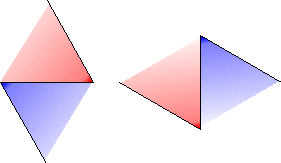
The Z plasty results from the paired transposition of two triangular flaps. A common design uses equal size, equilateral triangle (60°) flaps, but many variations are possible. Although simple Z plasty is very useful in the treatment of flat surface scars, it may result in an unnatural "cleft" appearance when used for web space deepening. |
 |
| Transposition
flap
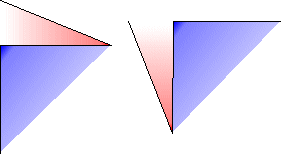
This design is a zig zag like a Z plasty, but more accurately is called a transposition flap. Here, the narrow flap rotates and the wide flap advances to close the narrow flap donor site. |
 |
| Designs using 3 flaps | |
| Square Flap
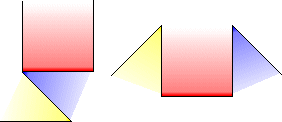
or Three Flap Plasty This can be thought of as a double transposition flap. The narrow flaps rotate, and the wide flap advances to close their shared donor site. At first glance, the blue and yellow flaps look like a Z plasty, but they rotate away from, not toward each other. |
 |
| Designs using 4 flaps | |
| "90-90" Flap
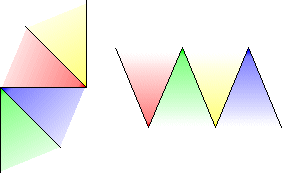
or Four Flap Plasty This unique design combines the Z plasty and the bilobed flap designs. At first glance, the center red and blue flaps look like a Z plasty, but look how far apart they wind up. This flap takes advantage of the unique geometry of the interdigital web. |
 |
| Multiple
Z plasties
A single tight band may be lengthened with a series of Z plasties. |
 |
| Double
Z Plasty
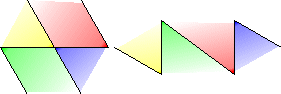
Z plasties may also be immediately adjacent to each other. This allows more flaps to be used in a narrow space, as in this double Z plasty. |
 |
| Designs using 5 flaps | |
| Butterfly
Flap
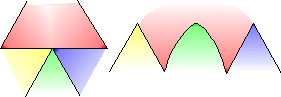
or Double Opposing Z Plasty This is a double Z plasty, with the flaps planned as mirror images. In addition to the two lateral Z transpositions, the upper (red) flap wraps around the additional inner (green) flap created with this design, increasing the length gain over a simple double Z design. |
 |
| Alternate
Butterfly Flap
Separating the Z plasties blunts the tip of the inner (green) flap, which improves the fit with the upper (red) flap. |
 |
| Jumping
Man Flap
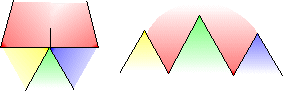
or Five Flap Plasty This is a modification of the double opposing Z plasty. The upper (red) flap is partially split to allow Y-V advancement of the inner (green) flap. Because this split narrows the vascular pedicle to the lateral flap tips, their angles are planned more obtuse (75°) than for a typical double opposing Z plasty. |
 |
| Alternate
Jumping Man Flap 1
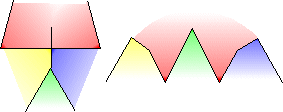
This design allows for greater Y-V advancement and lengthening. It requires supple skin other than the tight band itself. |
 |
| Alternate
Jumping Man Flap 2
This design places greater emphasis on the lateral Z plasties and less on Y-V advancement. It is more appropriate for use in a heavily scarred bed. |
 |
|
|
|

|
|

|
|
| Advancement Flap Designs | |
|
V-Y Flap Modest length gains can be achieved with a transversely oriented V-Y flap. Best application is lengthening a linear scar when geometry prevents the use of transposition flaps. |
 |
| Multiple
Y-V Flaps
No flap rotation is required, and the lenthening achieved is less than for the other multiple flaps illustrated. The final result resembles that of the 5 flap plasties above. |
 |
| V-M
Plasty
This is actually an extension of the Y-V principle, and is appropriate for dorsal burn syndactyly. |
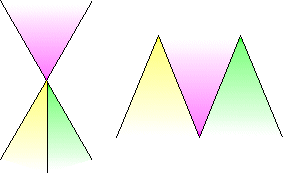 |
| Modified
V-M Plasty
The V-M plasty results in lateral "dog ear" skin redundancy, which may be incorporated into the flap design to increase lengthening. |
 |

